A Conversation with Victoria Kiolawson, Founder of NextGem Foundation
Victoria Kiolawson is the founder of NextGem Foundation, a Nigerian non-profit building structured platforms and pipelines for orphaned children across all 36 states. This is her story — in her own words.
Before NextGem, before the Orphanage Games — what were you actually looking for when you came to Bayelsa for NYSC?
Honestly? A Sunday school to teach in.
That's what I'd been doing in Port Harcourt — Sunday school teacher, children's ministry, that kind of thing. I've always been drawn to holistic child development. So when I got to Bayelsa, I was looking for a church to plug into on Sundays.
But God gave me a different idea. He said do it at an orphanage instead. And I obeyed.
So I found Destiny Child's Orphanage, I introduced myself to Mrs. Peace, and I started showing up every Sunday. That was the beginning of everything.
So the children came first. Not the foundation.
The children filled a gap in me first, if I'm being honest.
And something I noticed quickly — whenever I told people I was volunteering at an orphanage, they'd look at me like I'd said something strange. "Where did you find an orphanage? Do people even volunteer at orphanages?"
That told me something. Not just about the children being invisible, but about how invisible the whole sector was to ordinary Nigerians. These orphanages are not far away. These children are not hidden. People just don't know they exist, or don't think about them as somewhere you can actually go and help.
So from the beginning, my goal was dual: give my children more visibility, and make society realise that yes — these children exist, and they are not that far from you.
And that's how the Orphanage Games was born?
started because I wanted to do something for the children I was already volunteering with. All of it was for them.
But as the idea grew, I realised it needed more participants — so it expanded to other orphanages. And then the question became: how do you make this a real event, not just a visit?
I'm a Christian. I believe when God sends you to do something, He makes sure it happens. And I fought so many battles during the planning of the Orphanage Games. But I did not give up because I truly believed this was something God wanted. That conviction is what kept me going.
The event happened. And the response was not polite applause — it was genuine. Children who spent most of their days as the objects of other people's charity, spending one full day as athletes, as competitors, as kids. That was the point.
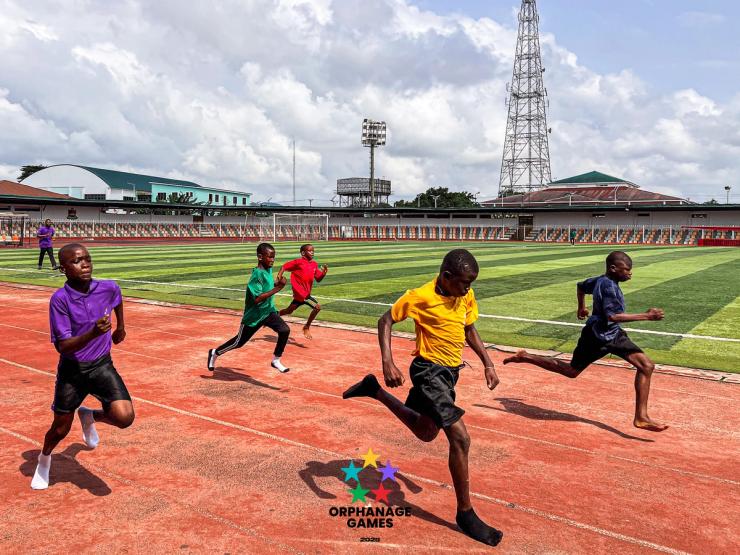
100M RACE (MALE) AT THE 2025 ORPHANAGE GAMES
After the Orphanage Games, everyone was telling you to start a foundation. You hesitated. Why?
It wasn't fear, really. I genuinely like to work. But I have to believe in what I'm working on first.
The Bible says to count your cost before you build anything. And I had real questions. What would a foundation even do? Would it be just for children, or for orphanages specifically? What would we spend money on? How would we make it accountable? Would we stay in Bayelsa or try to scale?
I also didn't want to ride on what some people were calling my "success" and then walk in my own strength. The Orphanage Games had God's hand in it — I knew that. But a whole foundation? I wasn't sure yet.
I remember during the planning of the Orphanage Games, Mrs. Joy — the matron at Daisy's Home for Special Children — told me plainly: "This thing will be your foundation, and you will work with only orphanages." At the time I just smiled and kept planning. I honestly thought the Orphanage Games was a one-time thing for my service year.
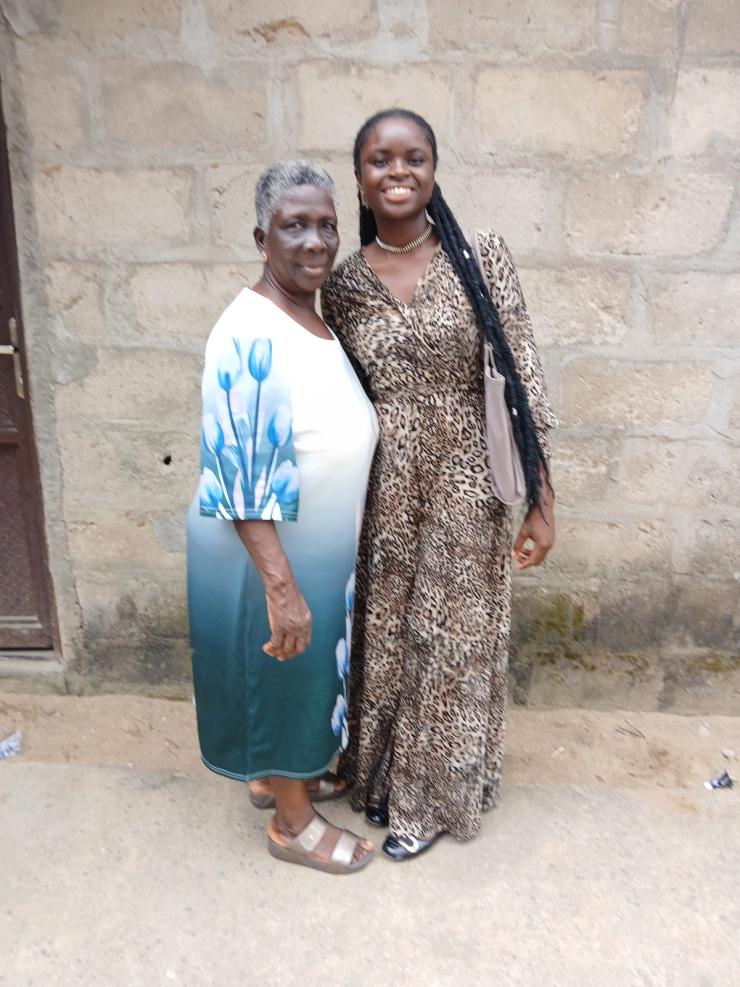
Mrs Joy, President of Daisys Home for Special Children and the NextGem Foundation Founder, Victoria Abiye Kiolawson
Even when people asked about a 2026 edition, I'd just smile and look away. Talkless of opening a whole foundation.
But I kept watching. I kept praying. And in March 2026, I had my answer.
What do people get wrong about orphaned children when they talk about "helping" them?
The shortsightedness.
Don't get me wrong — bringing food, rice, toiletries — that helps. Imagine feeding 50 children a day. A bag of rice is genuinely useful. I'm not dismissing that.
But my problem is that it stops there. There's no holistic view. What about jobs? Skills? Education? A future beyond maybe becoming a petty trader?
And I can't even blame the orphanages, because they're already stretched impossibly thin. Feeding those children every day is an achievement on its own. So that's exactly why NextGem exists — we let the orphanages take care of the present, the day-to-day, the feeding and shelter and love. And we take care of the future.
It's like co-parenting. (laughs)
What's the part of this work that people don't see?
Convincing people that this actually matters.
People hear "orphan foundation" and they think charity. Feel-good movement. Nice Instagram photos.
But this is so much more than that. These children will not be children forever. They will grow up. They will enter society. And then what?
As difficult as it is to say — some orphanages today are the breeding grounds for tomorrow's criminals or derelicts. Not because anyone wants that. But because nobody invested in their future. NextGem wants to ensure that instead of that, we produce the next governors, senators, musicians, mathematicians, dancers, instrumentalists.
Both my parents are alive and well. I can say honestly that my life would be almost impossible without them — the opportunities they gave me, the experiences they made sure I had, the investment they made in my future. I want these children to have even a fraction of that.
I wish people would stop seeing only charity cases. And start seeing part of the next generation.
Last question. Finish this sentence: "I started NextGem because I was angry about ___"
The uncoordinated system.
I looked around at the minimal — or complete lack of — structure in the orphanage sector. I saw how the children were affected by it. And I didn't see any other way to fix it than to build the solution myself.
I want advocacy for these children. I want to give them a seat at the table.
And I want to run this foundation with the kind of integrity that feels almost uncommon in Nigeria. With accountability. With real, physical results that the world can see and my children can feel.
That's the whole thing, really. That's NextGem.
——
Victoria is a speaker and advocate for Orphan Development across Nigeria. She gives talks to churches, youth leadership programs, corporate events, and conference-style stages. Invite her to speak by contacting abiyeson@gmail.com or visit her website at abiyekiolawson.nextgemfoundation.com
——————
NextGem Foundation is a registered Nigerian non-profit operating across Bayelsa State and building toward a national presence in all 36 states.
Follow the foundation's work on Instagram and LinkedIn @nextgemfoundation, or reach out at nextgemfoundation@gmail.com