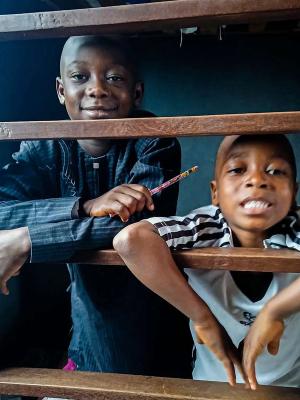
If you ask most Nigerians what orphanages need, they will tell you
the same things. Food. Clothes. Toiletries. Maybe school fees.
They are not wrong. But they are also not looking deep enough.
Nigeria's orphan care system is under enormous strain, and the
dominant response to that strain — well-meaning individuals and
groups showing up with packaged goods around Easter and Christmas —
does almost nothing to address the underlying problem. In some ways,
it makes the problem harder to see clearly, because it creates the
impression that the system is being supported, when what is actually
happening is much more fragile.
This is what is actually happening.
The scale of the problem is real and it is growing.
Nigeria has an estimated 17.5 million orphaned and vulnerable
children. There are only 278 listed orphanages providing shelter
and care nationwide, according to recent reporting. That gap — between
the number of children who need structured care and the number of
homes equipped to provide it — is enormous, and it is widening.
ASOHON, the Association of Orphanage Homes Operators in Nigeria,
warned in 2023 that the country simply does not have enough homes
to accommodate the need, and that the government continues to
leave the burden almost entirely to NGOs, faith communities, and
private individuals who are running on donations and determination.
The situation is compounded by ongoing displacement. UNICEF's 2024
data shows that approximately 60 percent of the nearly 3 million
internally displaced people across Nigeria's conflict-affected
regions are children. Armed groups abducted 859 schoolchildren in
2023 alone. The northeast has been in protracted conflict for over
fifteen years. Every wave of violence produces a new generation of
children without parents, and Nigeria's institutional care system
is not growing fast enough to receive them.
The homes that exist are fighting to survive.
Research into Nigerian orphanage conditions paints a consistent
picture: chronic underfunding, understaffing, and facilities that
in many cases lack basic infrastructure. Some orphanages, particularly
in rural areas, operate without reliable electricity or clean running
water. Educational programmes are often underfunded. Children with
special needs are among the worst affected, frequently without access
to the trained staff or adaptive equipment their development requires.
Because the government does not guarantee social security for
orphaned children, private homes exist in a state of permanent
financial precarity. As the president of ASOHON put it: "The only
source of survival for most private homes is charity. And because
funding depends on charity, there are wild fluctuations in the
performance of private homes, often to the negative side."
What happens to the children inside those fluctuations is not
difficult to imagine.
What happens when orphanage children age-up?
Compounding all of this is what happens when children age out.
Nigeria's Child Rights Act, passed in 2003, contains no provisions
for children after they leave care. Most orphanages provide support
up to a certain age — often 15 or 18 — and then the child is
expected to reintegrate into a society that does not know they exist
and a labour market that requires qualifications they often were not
adequately prepared for.
Research on care leavers in Nigeria consistently documents the same
outcomes: limited education, high unemployment, housing insecurity,
psychological wounds that accumulated across years of institutionalised
care without adequate emotional support, and — for those from homes
that were underfunded or poorly managed — the compounding effects of
childhood neglect. In a country where nearly half of children and
adolescents already live in households below the national poverty
line, the care leaver starts even further behind.
The problem is not just that they lose their parents. It is that
the system designed to hold them until they can hold themselves
frequently cannot hold them well enough.
So what do orphanages in Nigeria actually need?
What do orphanages in Nigeria actually need?
They need consistency, not episodic generosity. Regular, reliable
funding — even small but predictable monthly contributions — is far
more useful to an orphanage director than a large one-off donation
that cannot be planned around.
They need skilled support. Teachers, counsellors, healthcare workers,
coaches, administrators — people who can strengthen the internal
capability of the home, not just supplement its consumables.
They need structured programmes. Activities that develop children
holistically — academically, physically, emotionally, and socially.
Not because children in orphanages need more programming, but
because structure is what turns an institution into an environment
where a child can genuinely grow.
They need to be seen properly. Not as permanent charity cases, but
as homes that are doing serious work under serious constraints, run
by people who deserve the same level of professional respect that
any social service operator deserves.
And the children inside those homes need to be seen the same way.
Our Solution
At NextGEM Foundation, we operate from a single starting point:
a child in an orphanage is a child. They are not a problem category.
They are not a symbol of national failure. They are not content for
your Christmas post.
They are children, with the full range of needs, capacities, and
potential that every child carries. They deserve education. They
deserve play. They deserve structured investment in who they are
becoming. They deserve to be raised, not just housed.
Our programmes — including the Orphanage Games, our mentorship
initiative, and our partnerships with homes in Bayelsa State — are
built entirely around that belief.
If you want to support that work — through funding, partnership,
volunteering, or advocacy — we want to hear from you.
nextgemfoundation@gmail.com
@nextgemfoundation on Instagram and Facebook
A future for every orphan.